
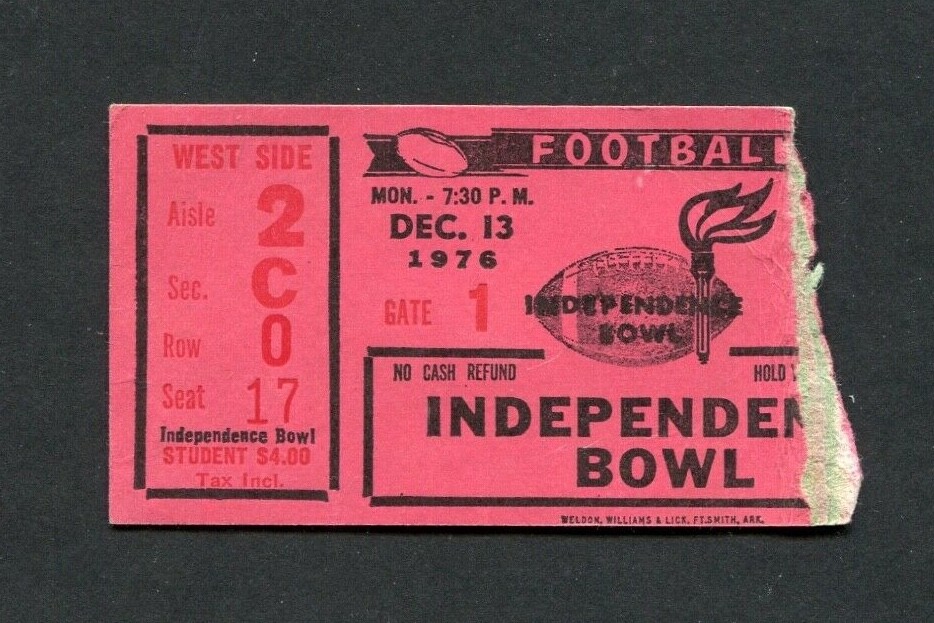
The narrative these days is clear: there are too many bowl games.
The LA Bowl announced that it has played its final game, and ESPN (through Kirk Herbstreit) has started airing its thoughts on recent bowl proliferation. With the Independence Bowl’s ESPN contract expiring after today’s game, and considering the online vitriol about a bowl game in Shreveport, one could expect the I-Bowl might be headed for the chopping block.
But before we write off this piece of college football history, let’s look back at its remarkable story. Especially its relationship with Louisiana Tech.
The Declaration of Independence (Bowl)
To understand the Independence Bowl, we need to rewind to 1975. That year, Louisiana Tech’s conference, the Southland, jumped from the College Division to the University Division – essentially the equivalent of an entire conference moving from Division II to Division I today.
In the College Division, there had been bowl games as part of a playoff system. Tech knew this world well; they’d been the #1 seed in 1974, won an on-campus playoff game against Western Carolina, then lost to Central Michigan in the Pioneer Bowl semifinal.
But the University Division had no playoff. Just 11 bowl games, and most of the 22 available slots went to major conferences. The bowls without conference ties preferred larger schools who could sell more tickets. So the only way to guarantee a small conference champion would make a bowl game was to create one.
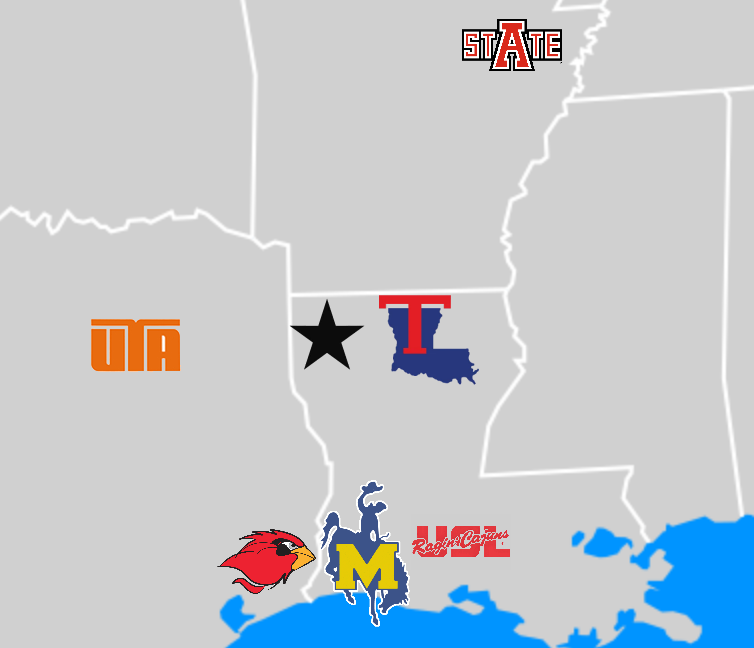
And after the Southland watched Arkansas State go 11-0 in 1975 (including a win over Memphis in the Liberty Bowl’s own stadium) without receiving a bowl invite, the conference knew they needed to create a bowl game for themselves. And Shreveport, with its centrally-located stadium that only hosted high school games and the annual Tech-Northwestern State State Fair matchup, was the perfect spot.
The naming choice was curious, though. As a one-off game for the 1976 bicentennial, calling it the “Independence Bowl” made sense as a patriotic nod to America’s 200th birthday. But keeping that name moving forward especially when it wasn’t designed for Division I “independent” teams was confusing at best. And it remains, in my opinion, a branding mistake.
The Early Days of the Independence Bowl
For the inaugural 1976 Independence Bowl, McNeese State earned the Southland’s automatic bid by beating ULL in their regular season finale. The I-Bowl committee invited undefeated #17 Rutgers as their opponent, but the Scarlet Knights declined, thinking that the Independence Bowl was beneath them.
With the Scarlet Knights preferring New Jersey in December, Ohio Valley co-champion Tulsa stepped in. McNeese defeated the Golden Hurricane and showcased exactly what the bowl’s organizers had hoped for, a Southland victory on a larger stage.
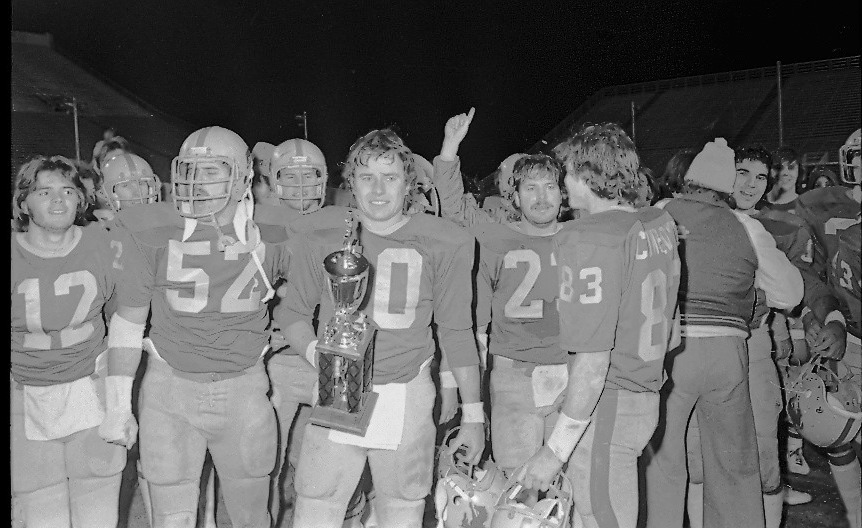
Louisiana Tech entered the picture the next year, winning the Southland and earning the auto-bid. They faced Louisville, an independent school, who finally putting the “Independent” in Independence Bowl. Tech dominated, scoring 24 straight points in the first half following a Louisville punt return TD, earning both their first I-Bowl appearance and their first I-Bowl victory in a game that “featured” 13 combined fumbles by the two teams.
Tech returned the next year in 1978 for what would be Coach Maxie Lambright’s final game, but independent East Carolina spoiled the party with a 35-13 victory, forcing four fumbles and grabbing three interceptions.
McNeese won the Southland in 1979 and 1980, returning to the I-Bowl both years but losing to Syracuse and Southern Miss respectively. It would be the last time McNeese ever played in a bowl game. Because it was the last year where Southland teams would be eligible for bowl games at all.
The Great Schism of College Football
The college football landscape shifted dramatically in the late 1970s. The Notre Dames and Nebraskas of the world grew tired of sharing Division I with smaller schools like East Tennessee State, Louisiana Tech, and Yale. So they split Division I into I-A and I-AA in 1978.
The problem? Almost nobody wanted to move down to I-AA. Of 144 Division I teams, only the SWAC schools and Northwestern State took the bait. Meanwhile, UNLV perfectly read the room and jumped straight from Division II to I-A. Instead of reducing I-A to around 79 teams, it remained at 139.
The big schools got their way anyway. Going into the 1981 season, the NCAA imposed restrictions on staying at the I-A level, and the Ivy League, Southern Conference, and Southland were relegated to I-AA.
For the Independence Bowl, this was a crisis. Without the Southland’s automatic bid, they had to convince two teams to play in Shreveport every year. Moving the bowl game down to I-AA wasn’t an option either as the I-AA playoff no longer featured bowl games.
But with fewer schools at the I-A level and only 16 bowl games total, major programs became less quick to decline I-Bowl invitations. Throughout the 1980s, “name-brand” schools made the December trip to Shreveport.
Louisiana Tech's Return to Shreveport
The 1990 Independence Bowl showcased the challenges of being a mid-tier bowl. The I-Bowl wanted Baylor, but needed an answer before the Bears’ final regular season game against Texas. Baylor hoped a win over the Longhorns would earn them a Cotton Bowl bid, so they declined. They lost to Texas, missed the Cotton Bowl anyway, and sat home during bowl season.
Instead, Louisiana Tech, now back at Division I-A as an independent, received their first bowl invite since the move. And with the annual State Fair game against Northwestern State now a relic of the past, the year prior (1989) was the first since World War II that Louisiana Tech had not played a game at what was now Independence Stadium.
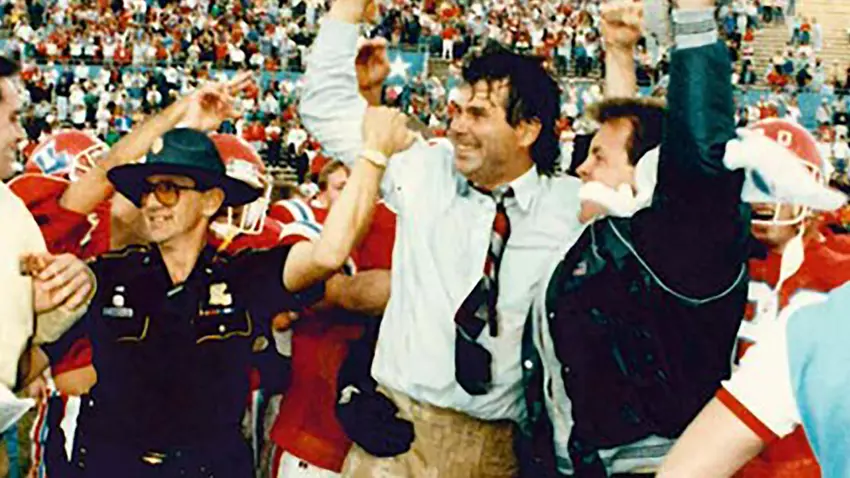
The 1990 game ended in a tie, the only one in I-Bowl history. It was also notable for another reason – it was the first game with a title sponsor.
While the John Hancock Sun Bowl had started the sponsor trend five years earlier, “Poulan Weed-Eater Independence Bowl” shaped perceptions that the Shreveport bowl didn’t deserve to hang with college football’s elite. Another branding mistake.
The Changing Landscape
Not helping the prestige factor was that from 1980 to 2008 the number of bowl games nearly doubled from 19 to 32. The Independence Bowl still attracted name-brand programs, but the quality of those competing teams declined. For example, the last ranked team to play in Shreveport was in 1994.
In 1995, the I-Bowl secured a deal with the SEC to host their sixth-best team. The first year of that agreement delivered 6-4-1 LSU and most years over this stretch featured matchups between 7-5 or 6-6 Power Five schools.
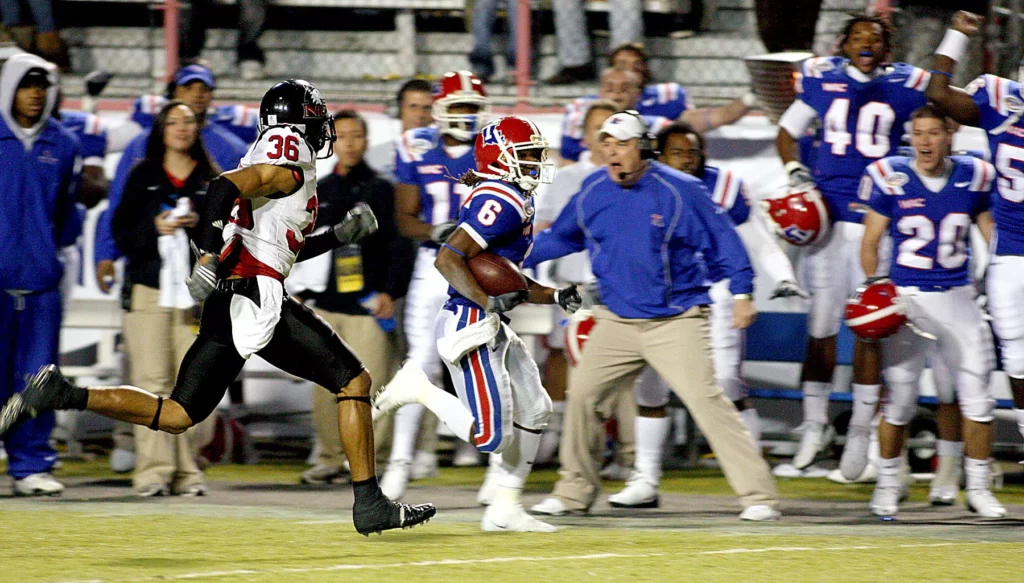
The 2008 game between WAC’s Louisiana Tech and MAC’s Northern Illinois signaled a shift away from barely-eligible P5 programs. After hosting an SEC school in 12 of the previous 13 years before 2008, only three would appear over the next 13.
But for Louisiana Tech, who had only one bowl appearance in the previous 18 years since its last appearance in the Independence Bowl, it provided an opportunity. And the Bulldogs stayed off the list of three bowl-eligible teams left out of postseason play, a list that included former Southland partners Arkansas State and ULL.
Recent History
The 2012 Independence Bowl is probably deserving of its own post. Depending who you ask, the 9-3 Bulldogs were either afraid of facing in-state rival ULM or holding out hope for the older, more prestigious Liberty Bowl.
Tech mended any bridges that needed mending in 2019, completing their sixth straight bowl win in six different bowl games with a victory over Miami.
And last year deepened the partnership. When Marshall pulled out citing transfer portal losses, nearby 5-7 Louisiana Tech assembled a team on short notice, even though it resulted in a blowout loss to Army.
Why It Matters
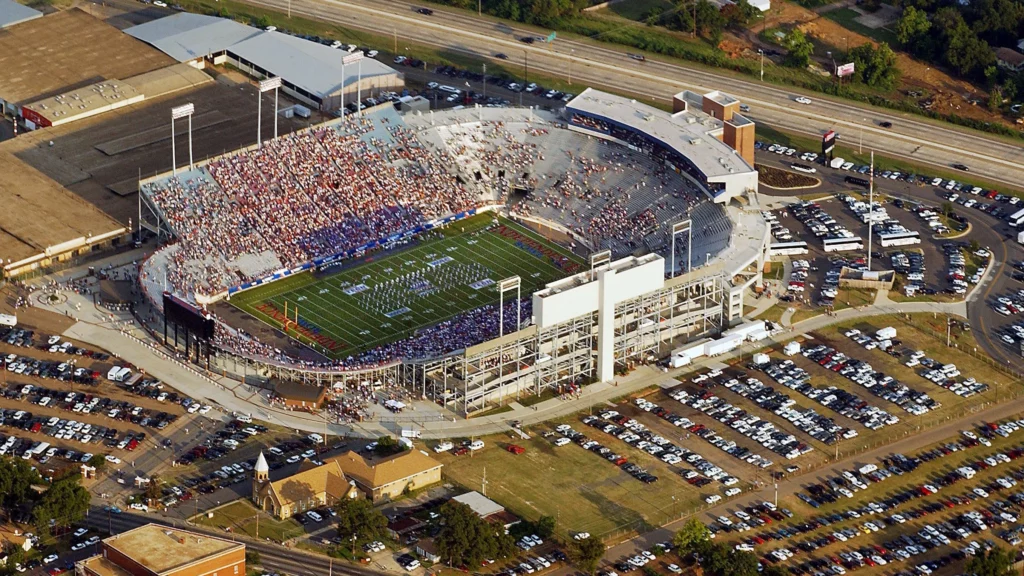
I truly hope this isn’t the last Independence Bowl. And not just because of the mutually beneficial relationship between the I-Bowl and Louisiana Tech. This is the 11th oldest bowl game in college football, and it has provided a stage for smaller and larger schools to compete nationally for nearly 50 years.
And it’s about Shreveport – a city that’s become a punchline, while watching sports team after sports team leave over the years. They deserve something nice. They deserve their bowl game.
While small schools seeking national exposure may suffer from bowl game reductions, the Independence Bowl represents more than just another postseason exhibition. It’s a reminder that college football’s story isn’t just written by the blue bloods, but by the programs and cities that have fought to earn their place at the table.